What Is NRC and What Does Quiet Denim™ Insulation’s 1.05 Rating Mean?

If you’ve been researching insulation for soundproofing, you’ve probably come across the abbreviation NRC. It’s one of the most useful numbers for understanding how well an insulation material handles sound, and it’s also one of the clearest ways to compare options before you buy. Here’s what it means and why it matters:

What NRC Stands For

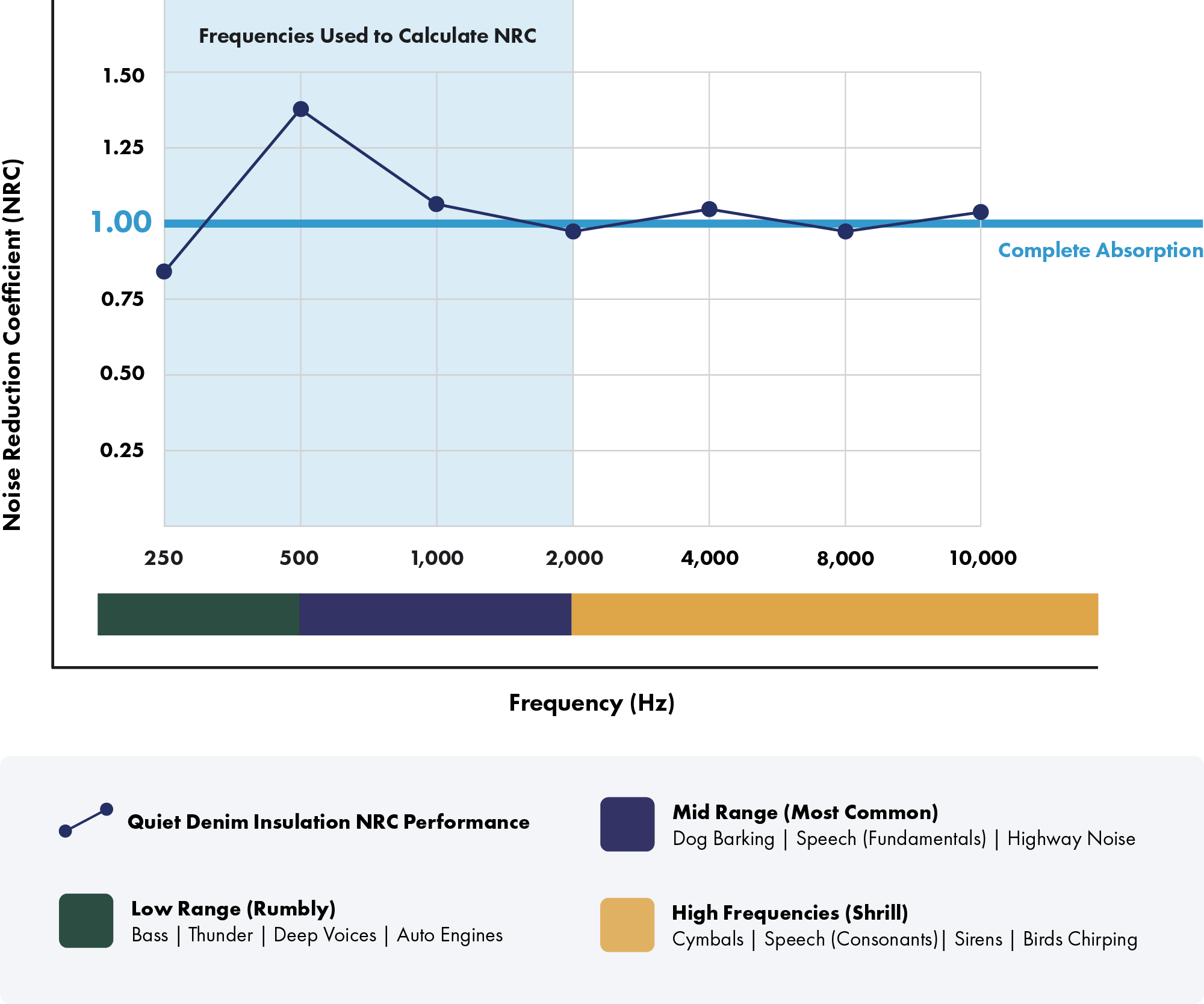
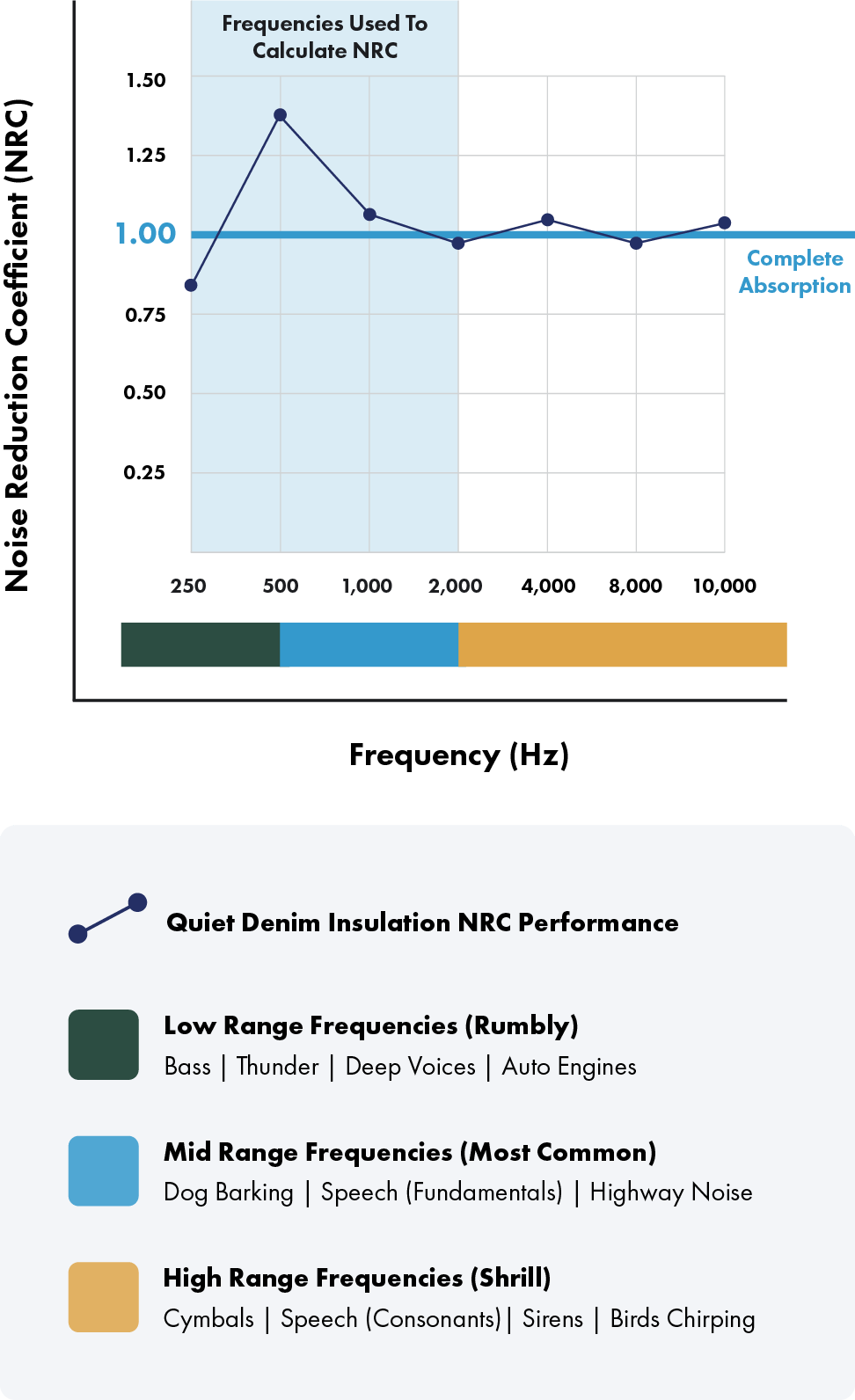
NRC stands for Noise Reduction Coefficient. It is a rating used to measure a material’s sound absorption effectiveness, calculated by averaging its sound absorption coefficients at 250, 500, 1,000, and 2,000 Hz, rounded to the nearest 0.05.
 
Those four frequencies roughly correspond to the range of human speech, which makes NRC particularly relevant for interior walls, where conversations, plumbing noise, and everyday household sounds travel most.

How the Scale Works

NRC is an efficiency rating for sound absorption, ranging from 0.00 (reflecting everything back like concrete or glass) to 1.00 (absorbing virtually all sound that contacts it).
 

In practical terms:

  • A material with an NRC of 0.00 sends all sound bouncing back into the room.
  • A material with an NRC of 0.50 absorbs half the sound energy that contacts it.
  • A material with an NRC of 1.00 absorbs virtually all of it.


Most acoustical panels fall between 0.40 and 0.90, with higher values indicating better sound absorption.

Quiet Denim NRC Rating: 1.05
Quiet Denim NRC Performance: 1.05 | Premium Absorption

What About Scores Above 1.0?

You may notice that Quiet Denim’s NRC is listed as 1.05, sitting above the standard ceiling of 1.0. This is not a measurement error. Values greater than 1.0 can occur in reverberation room testing due to measurement effects, such as edge diffraction and non-ideal diffuse-field conditions, rather than because the material absorbs more than 100% of sound energy. It is a known artifact of the testing standard and indicates exceptional absorption performance.

NRC vs. STC: Two Different Things

NRC is frequently confused with STC, which stands for Sound Transmission Class. They measure different things entirely.
 
STC relates to sound transmission loss through a construction element, such as a wall, door, or window, while NRC relates to sound absorption within a room by surfaces and treatments, such as those that dampen echoes and reverberation.
 
In plain terms, STC measures how much sound passes through a wall. NRC measures how much sound a material soaks up. Both matter for a quiet interior. Quiet Denim’s NRC of 1.05 tells you how effectively it absorbs sound within the cavity. The STC rating of the finished wall assembly depends on additional factors, including drywall, framing, and construction method.

How Does Quiet Denim’s 1.05 Compare?

Material
NRC Range
Fiberglass
0.90-0.95
Stone Wool
0.80-1.05
Quiet Denim
1.05

The two most common alternatives to recycled denim insulation are fiberglass and stone wool. Here’s how the NRC numbers stack up:

Standard fiberglass batt insulation, 3.5 inches thick, has an NRC rating of 0.90-0.95. Higher-quality soundproofing stone wool sits between 0.95 and 1.05, while multipurpose stone wool ranges from 0.80 to 0.90.

Quiet Denim’s tested NRC of 1.05 places it at the top of that range, matching the best-performing stone wool products on acoustic absorption while being safe to handle bare-handed during installation. Unlike fiberglass, it contains no glass fibers that cause skin and respiratory irritation. Unlike stone wool, it is made from 85% post-industrial recycled denim rather than virgin rock or slag.

Why It Matters for Your Project

NRC becomes most useful when you’re insulating spaces where sound quality or privacy matters: bathrooms, bedrooms, home offices, media rooms, and any shared wall where noise from one room affects another.
 
NRC works well for representing acoustical absorption in mid-range speech frequencies, but if your concern is low-frequency bass or high-pitched mechanical noise, looking at the full frequency breakdown rather than the single NRC number gives a more complete picture.
 
Quiet Denim’s full test results show strong performance across a broad frequency range, making it ideal for residential and commercial construction. The complete data is available right here.

What NRC 1.05 Actually Feels Like to Live With

Numbers on a spec sheet don’t tell you what it’s like to cook dinner while your partner is on a work call in the next room, or to sleep through your teenager’s midnight snack run. What a well-insulated interior wall actually delivers is simpler than the data suggests: conversations stay in the rooms where they happen, bathrooms stay private, home offices become functional, and the baseline noise floor of daily life drops in a way that’s hard to pinpoint but immediately noticeable. It’s the difference between a house where you’re aware of everyone in it and one where you’re not.

The Bottom Line

NRC is a straightforward number once you know what it measures. Higher is better; the scale runs from 0 to 1.0 in standard usage, and scores above 1.0 indicate top-tier absorption performance. Quiet Denim’s 1.05 is among the highest ratings available for a batt insulation product installed in a standard wall cavity.

Project estimator

Use our project estimator to help get your project up & running.

Get a quote

Reach out for a quote and our team will get back to you.

Quick Calculator

For the most accurate calculation, use our project estimator.